
The snake print chain-strap mini flap bag occupies an unusual position in the handbag sourcing landscape: visually high-impact, structurally simple. A flap, a boxy body, a chain—there is nowhere for a manufacturing defect to hide. In 2026, snakeskin is positioned as the “exotic/editorial” animal print, outpacing leopard as the freshest choice across runway and editorial coverage, and it demands a higher level of surface consistency and hardware reliability than solid-color or basic-print bags. This guide, prepared by Qingyuan Hongjin Bag Co., Ltd., a B2B bag manufacturer supporting OEM, custom production, and private label programs, breaks down the three decision nodes that define a snake print chain bag program: surface technique selection, chain-to-body load structure, and the parameter and compliance baseline that belongs in the specification sheet.
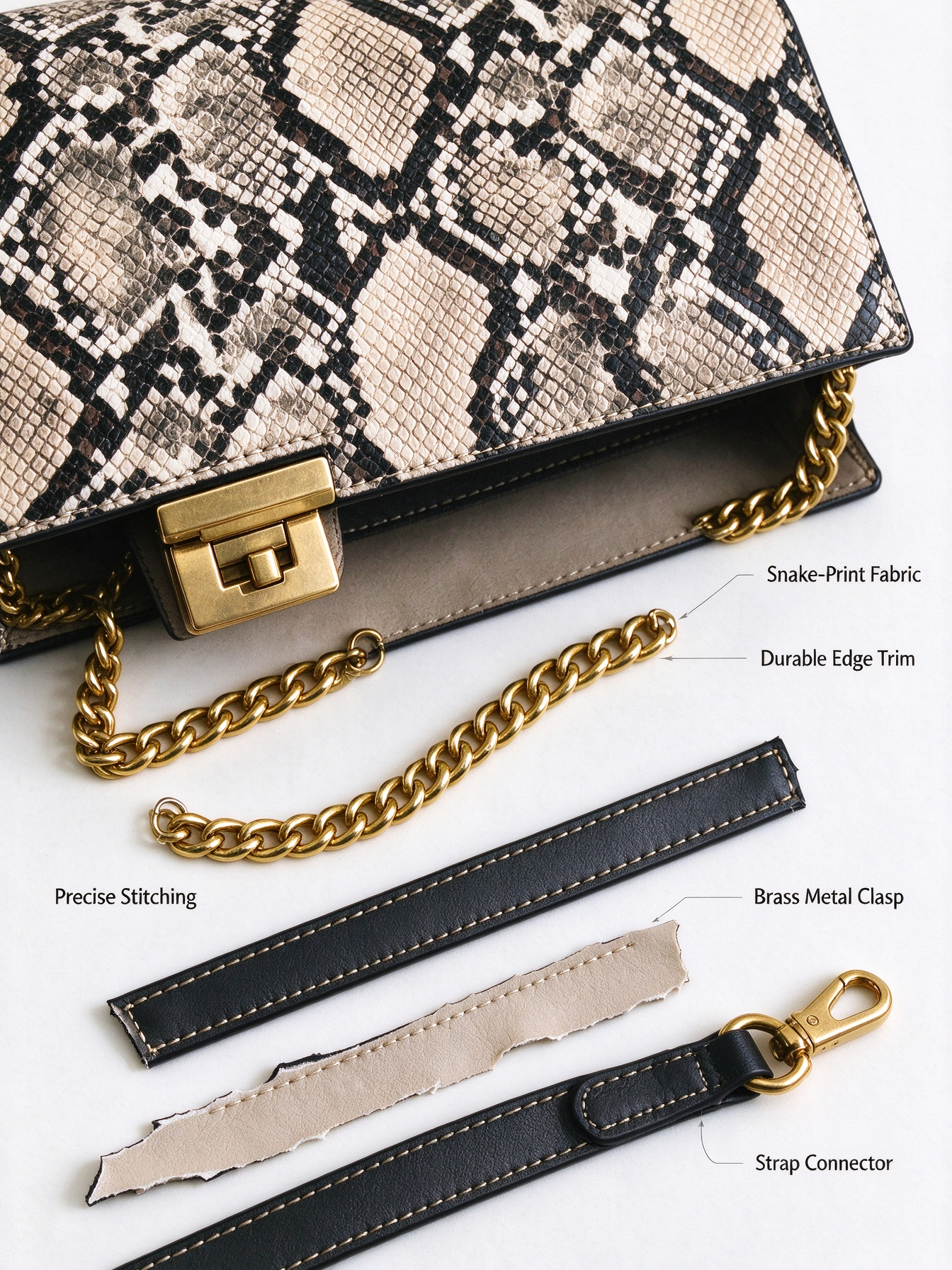
1. Snake Print Is Not One Material—It Is Three Sourcing Routes
In B2B terms, a “snake print chain bag” does not refer to a single material. It refers to three fundamentally different production routes, each with its own supplier base, MOQ structure, cost profile, and durability behavior.
Route A: Embossed PU. A textured roller presses a snake-scale pattern into the PU surface. Pattern depth and clarity depend on roller precision and backing thickness. This is the most common route for boutique and fast-reaction programs; visual control is strong and batch consistency is better than printing. The weakness is that embossed texture can flatten in high-flex zones, placing a hard requirement on the backing’s flex resistance.
Route B: Printed PU or microfiber. Digital or transfer printing reproduces the snake pattern. Color depth and gradient transitions are richer than embossing, making this route suitable for high-contrast, multi-tone snake designs. The risk sits in the print layer’s rub-fastness—dark snake patterns on light grounds are particularly vulnerable in wet-rub testing.
Route C: Laminated/film construction. A snake-effect film is laminated to a substrate, producing the sharpest, most three-dimensional texture and the closest visual read to “exotic skin.” Cost is higher, and delamination resistance (peel strength) becomes the critical failure parameter.
The sourcing decision should not start with “which is cheapest.” It should start with the target retail band, intended service life, and compliance exposure. Table 1 provides a factory-side parameter framework for each route.
Table 1. Surface technique comparison for snake print chain bag B2B programs
| Route | Texture read | Indicative FOB cost band | Key risk | Suitable retail band |
|---|---|---|---|---|
| Embossed PU | Medium clarity; good batch consistency | Lower | Flattening in flex zones; insufficient backing flex life | Mass boutique / fast fashion |
| Printed PU / microfiber | Rich color, natural gradient | Medium | Dry/wet rub-fastness degradation | Mid-market fashion brands |
| Laminated / film | Sharpest, most dimensional | Higher | Peel strength failure—bubbling or delamination | Premium / designer |
Indicative cost bands exclude chain, hardware, and packaging. Actual quotation follows specification confirmation.
Qingyuan Hongjin Bag Co., Ltd. can confirm the surface route and substrate combination against a buyer’s reference sample or target price band before sampling begins, reducing the common “film sample, print bulk” downgrade risk. Inquiries: admin@hongjin-bag.com.
2. PU Leather Hard Specs: Abrasion, Flex and Colorfastness Belong in the Spec Sheet
The dominant material in snake print chain bags is PU leather, and its failure modes are concentrated. For bag-grade PU, the core performance gates are tear resistance, burst strength, abrasion resistance, and flex endurance. For a mini flap bag that opens and closes daily, carries chain load, and flexes at the flap hinge, three parameters are non-negotiable:
Taber abrasion. Weight loss ≤100 mg/1,000 cycles (ISO 5470-1) is the baseline for bag-grade PU. On embossed snake textures, the raised scale edges are the first surface to wear; deeper embossing raises the abrasion requirement on the substrate.
Flex endurance. ≥50,000 cycles without cracking at room temperature is the basic flex threshold for PU; low-temperature flex (−20°C) covers winter logistics and warehouse exposure. The flap hinge is the single highest-stress flex zone on a mini flap bag, and this parameter directly predicts whether edge cracking appears within months of use.
Colorfastness. Dry rub ≥4 and wet rub ≥3 (AATCC 8) must be verified on any printed or dyed snake surface. High-contrast snake patterns are especially prone to color migration under wet rub, particularly light-colored bodies carrying dark snake print.
Table 2. Core PU performance baseline for snake print chain bags
| Test | Baseline requirement | Reference standard | Relevance to snake print chain bags |
|---|---|---|---|
| Taber abrasion | Weight loss ≤100 mg/1,000 cycles | ISO 5470-1 | Raised scale texture wears first; deeper embossing demands more |
| Room-temp flex | ≥50,000 cycles, no cracking | GB/T 4689.4 / relevant QB/T | Flap hinge service life |
| Low-temp flex | −20°C, no cracking | GB/T 4689.21 | Winter logistics and storage |
| Dry rub colorfastness | ≥Grade 4 | AATCC 8 | Print-layer stability against light grounds |
| Wet rub colorfastness | ≥Grade 3 | AATCC 8 | Color migration under moisture/sweat exposure |
Qingyuan Hongjin Bag Co., Ltd. can arrange third-party testing against these parameters during sampling and attach the results to the signed reference standard and bulk acceptance protocol. Phone: +86-13501469599.
3. The Chain Is a Structural Component, Not a Trim: Attachment Load Is the Most Underestimated Risk
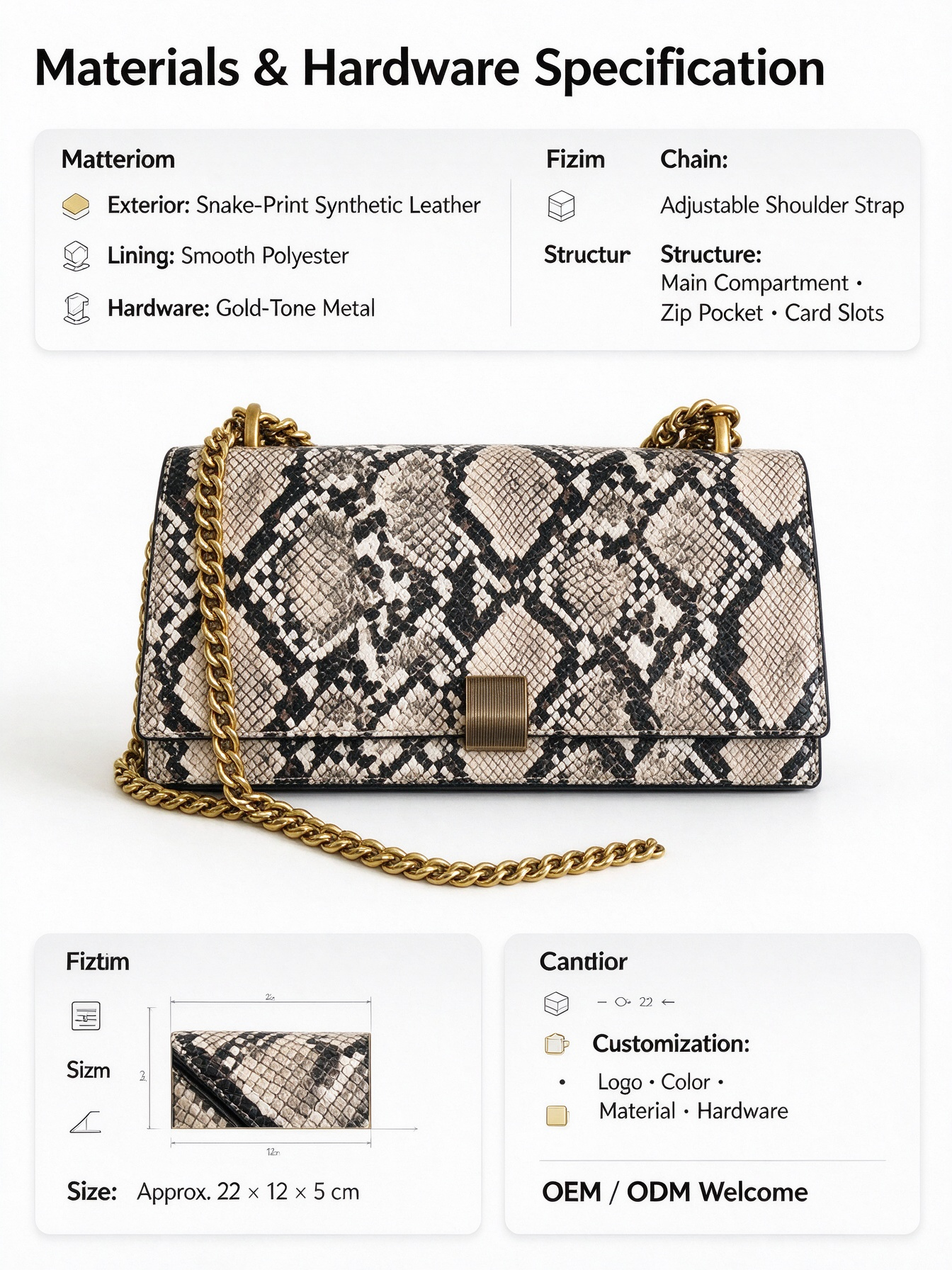
The visual focus of a snake print mini flap bag is the snake texture, but the high-frequency complaint point is the chain-to-body attachment. In B2B purchasing, the chain is often treated as “trim”; in reality it carries both decorative and load-bearing functions. A mini flap loaded with a phone, cardholder, and keys imposes dynamic, repeated loads on the attachment points, not a static hang.
Factory-side experience identifies three leading causes of early chain-bag failure: chain weight-to-body imbalance, D-ring or connector opening mismatch, and insufficient attachment reinforcement. The inner opening of the chain link must precisely match the D-ring or swivel-hook dimension—a mismatch that is invisible in a photograph but fails directly under pull testing.
Table 3. Chain and attachment specification decisions for snake print chain bags
| Parameter | Decision point | Procurement implication |
|---|---|---|
| Link inner opening | Must match D-ring / swivel hook | Mismatch concentrates stress; pull-test failure |
| Chain weight vs. body | Mini flap requires controlled chain gram weight | Overweight chain tilts the body and misaligns flap closure |
| Finish consistency | Chain, front clasp, and logo hardware on one color standard | Electroplating batch variation is a leading premium-bag complaint |
| Load/pull verification | Attachment pull test under loaded condition | Must be written into bulk acceptance criteria |
| Detachable design | Swivel-hook / lobster-clasp assembly security | Clasp becomes an additional failure point |
Hardware finish consistency also belongs in the specification. On a mini flap bag, the tiny hardware footprint amplifies any color deviation between chain, front clasp, and logo plate. The factory-side solution is to consolidate chain, clasp, and logo hardware into a single plating batch standard and inspect against an approved color standard during production. Qingyuan Hongjin Bag Co., Ltd. supports configuring chain, hardware finish, and body construction as a single project package.
4. REACH Compliance: Snake Print PU Is a High-Attention Category
Snake-effect surfaces rely on embossing, printing, or lamination, and PU leather sits in the higher-risk material category under REACH. For EU-bound snake print chain bags, three documentary gates should be cleared before the deposit is released:
SVHC screening. The SVHC candidate list continues to update, and a concentration above 0.1% (w/w) in any homogeneous material triggers notification and disclosure obligations. PU coatings, colorants, and surface treatments are potential SVHC sources.
Banned azo dyes. 22 aromatic amines, limit ≤30 mg/kg. The snake print coloration stage is the primary azo risk point.
Heavy metals and phthalates. Lead, cadmium, and nickel release are restricted under REACH Annex XVII; phthalates (DEHP, DBP, BBP, DIBP, etc.) carry elevated risk in PU synthetic leather, with a limit of ≤0.1%.
Table 4. REACH documentation checklist for EU-bound snake print chain bags
| Compliance item | Limit / requirement | Relevance to snake print chain bags | Document type |
|---|---|---|---|
| SVHC | ≤0.1% (w/w), 253 items and updating | PU coating, colorants, surface treatment | Third-party test report |
| Banned azo dyes | ≤30 mg/kg (22 amines) | Snake print coloration | Test report |
| Phthalates | ≤0.1% (6 substances) | High-risk PU item | Test report |
| Heavy metals (Pb/Cd/Ni release) | Per REACH Annex XVII | Hardware plating and colorants | Test report |
| Formaldehyde | ≤75 mg/kg (skin contact) | Lining and adhesives | Test report |
REACH has no “certificate”—substantive compliance rests on test reports plus a declaration of conformity. Buyers should lock the material formulation at sample approval and define the color and material scope covered by testing. Qingyuan Hongjin Bag Co., Ltd. can provide PU and hardware REACH test reports and material declarations. Email: admin@hongjin-bag.com.
5. MOQ and Lead Time: The Real Ranges for Chain Bag OEM
MOQ and lead time for a snake print mini flap bag are governed by two supply streams: the bag body and the chain hardware. Body MOQ is typically quoted per style per color, while the chain, as a separate hardware component, may carry its own minimum. The ranges below are factory-side references for 2026; actual figures are confirmed item by item against surface route, material stock, and hardware configuration.
Table 5. Typical MOQ and lead-time ranges for snake print chain bag OEM (factory-side reference, 2026)
| Configuration | Typical MOQ (per style/color) | Sample lead time | Bulk lead time |
|---|---|---|---|
| Stock style + logo | 20–100 pcs | 7–10 working days | 20–30 days |
| Existing body + new snake surface/color | 100–300 pcs | 10–15 working days | 25–40 days |
| Fully custom body + custom chain hardware | 300–500 pcs | 15–20 working days | 30–45 days |
Chain hardware may carry a separate MOQ; custom plating colors typically carry a higher threshold.
Two timing realities deserve emphasis: the sampling clock and the bulk clock are separate—a 15-day sample does not imply a 30-day bulk run; and custom plating colors on chain hardware extend the confirmation cycle because physical color-standard approval is a discrete step. Buyers should secure both figures in writing and tie them to milestone payments.
6. Factory Audit and Sample Approval: What to Inspect on a Snake Print Chain Bag
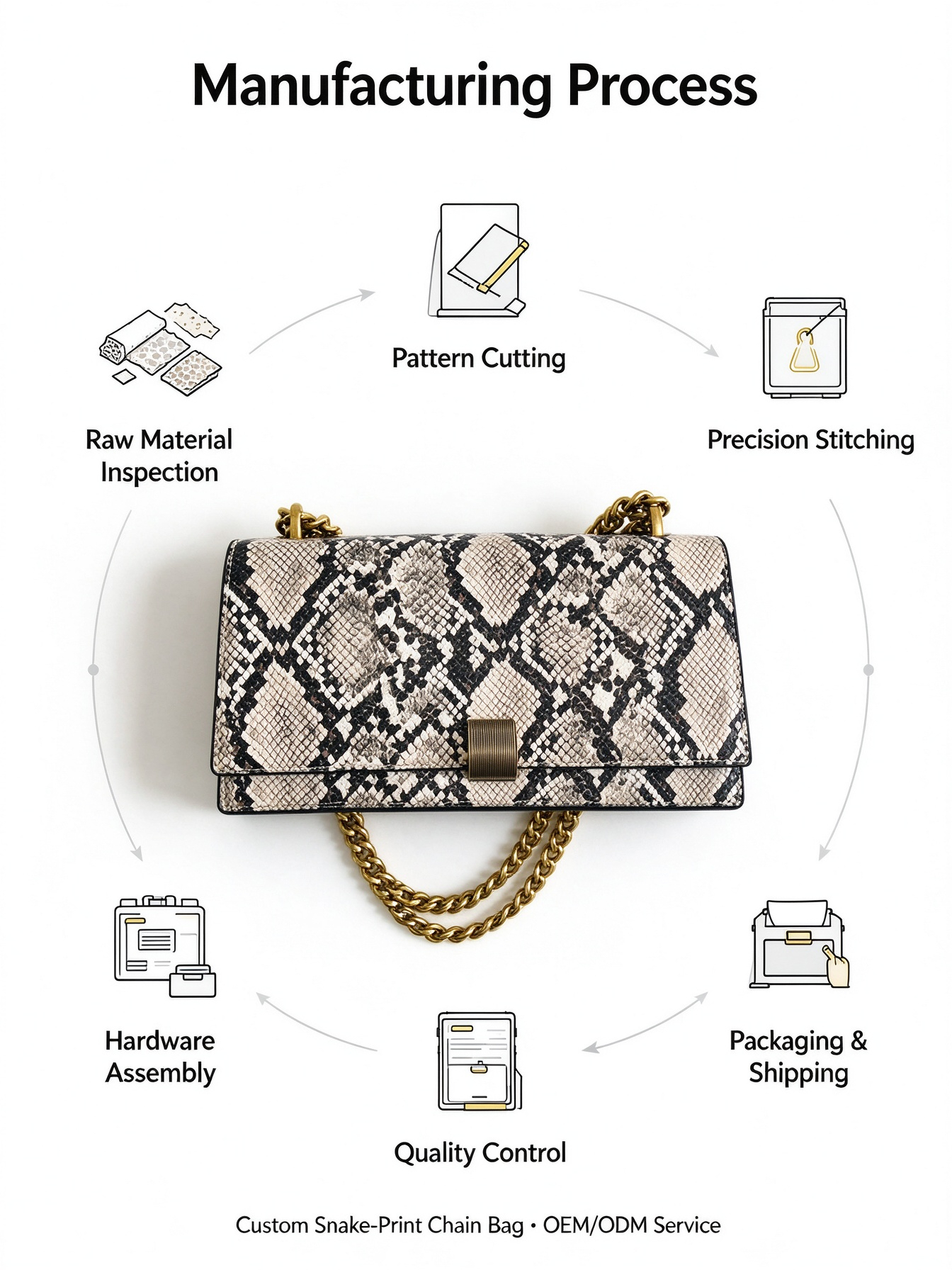
The audit focus for a snake print chain bag differs from canvas or solid-color programs. It should center on surface consistency and hardware assembly.
Inspect embossing roller or print-plate management. On the embossed route, roller wear directly affects texture consistency; on the printed route, plate and ink-batch management determines color reproduction. Request current roller or plate records for the production lot.
Inspect the chain attachment workstation. Chain-to-body assembly is a manual operation. Confirm whether a pull-test fixture exists, whether connectors are selected to specification, and whether the D-ring opening matches the link.
Signed samples must define the “minimum acceptable” snake texture state. The nature of snake print means texture position cannot be identical batch to batch. Approval should define an acceptable range for texture density, contrast, and scale clarity—not simply sign a “perfect sample.”
Pre-shipment AQL 2.5 inspection on first orders is not optional. Defects in this category concentrate in blurred texture, hardware color deviation, loose attachments, and flap closure misalignment. On a first order above 1,000 units, AQL 2.5 sampling costs far less than post-arrival sorting or returns.
About Qingyuan Hongjin Bag Co., Ltd.
Qingyuan Hongjin Bag Co., Ltd. is a B2B bag manufacturer supporting OEM, custom manufacturing, and private label services. For snake print chain bag programs, the company provides project-based support across surface technique selection, PU performance baselines, chain and hardware configuration, REACH compliance documentation, and MOQ/lead-time confirmation.
-
Company: Qingyuan Hongjin Bag Co., Ltd.
-
Email: admin@hongjin-bag.com
-
Phone: +86-13501469599
-
Business scope: B2B bag manufacturer | OEM | Custom | Private Label
Post time: Nov-02-2026