
The global backpack market entered 2026 at an estimated USD 22.87 billion, expanding at a compound annual growth rate of roughly 6.3% from the prior year. Within that total, canvas and natural-fiber constructions occupy a specific and durable niche: buyers in the heritage, lifestyle, promotional, and eco-positioned segments turn to canvas because it carries a tactile credibility that polyester and nylon cannot replicate at the same cost point. For B2B buyers—brand owners, wholesalers, corporate gifting agencies, and private-label retailers—the challenge is not whether canvas backpacks sell. It is how to source them without absorbing hidden costs in sampling, compliance testing, or post-shipment defect claims. This guide, prepared by Qingyuan Hongjin Bag Co., Ltd., a B2B backpack manufacturer supporting OEM, custom production, and private label programs, translates the factory-side realities of custom canvas backpack manufacturing into verifiable parameters: MOQs, lead times, fabric weights, hardware performance thresholds, duty exposure, and certification requirements. It is written for procurement teams that need numbers, not adjectives. Contact: admin@hongjin-bag.com; phone: +86-13501469599.
-
The Demand Case for Canvas in a Performance-Fabric Market
Canvas backpacks are not competing with technical hiking packs on waterproofness or with ultralight daypacks on gram weight. They compete on repeat-purchase reliability and brand permanence. Several structural demand drivers keep canvas in steady B2B rotation:
Sustainability pressure without technical compromise. Retailers and brands continue replacing single-use and short-lifecycle bags with reusable natural-fiber alternatives, and canvas sits at the center of that substitution. Organic cotton canvas and recycled cotton options command a 30%–50% material premium over conventional cotton in some sourcing channels, yet remain viable for heritage and lifestyle shapes where the story justifies the cost.
Corporate gifting and employee onboarding. Custom backpacks have become one of the most strategically valuable corporate merchandise categories, particularly for events, onboarding kits, and trade shows where utility and brand exposure must coexist. Canvas accepts embroidery and woven-label branding cleanly, producing a finished good that reads as a product rather than a giveaway.
Material innovation at the heavy end. Waxed canvas—built on a 12–16 oz/yard² cotton base impregnated with paraffin or beeswax—delivers water resistance without a PU coating and develops a patina that aligns with heritage brand positioning. Factory cost sits at roughly USD 22–35 per square meter, placing it above basic 600D polyester but below premium technical laminates. For EU-bound programs, the wax compound itself must satisfy REACH/SVHC requirements, a detail that separates compliant suppliers from assemblers. Qingyuan Hongjin Bag Co., Ltd. can review fabric, wax finish, and hardware compliance documents for custom canvas backpack OEM and private label projects according to the target market.
The takeaway for buyers is not that canvas is universally superior. It is that canvas occupies a defensible cost-performance band: above promotional polyester in perceived value, below full technical nylon in tooling complexity, and compatible with the sustainability documentation that a growing share of EU and North American accounts now require before issuing purchase orders.
-
MOQ, Sampling, and Lead Time: The Three Numbers That Define Project Economics
Every custom backpack order is governed by three interlocking figures—MOQ, sampling timeline, and bulk production lead time. These are not arbitrary thresholds set to inconvenience buyers. They are the visible surface of fixed costs that a factory must recover regardless of order size: pattern making, sample development, line setup, cutting tooling, operator training, and QC protocol establishment.
The arithmetic is straightforward. At 100 units, fixed costs spread across the order drive per-unit cost sharply upward; at 500 or 1,000 units, the same fixed cost burden becomes negligible per unit. This is why established canvas backpack factories typically set MOQs between 300 and 1,000 units per design and colorway for a fully custom specification, with some accepting 100–150 units only for simple designs using in-stock fabric. A factory that quotes an impossibly low MOQ without a price premium is usually either substituting stock components for custom ones or planning to recover margin somewhere downstream. As a B2B backpack manufacturer supporting OEM, custom, and private label production, Qingyuan Hongjin Bag Co., Ltd. confirms MOQ and lead time on a project basis according to design complexity, fabric stock, and hardware configuration.
Table 1. Typical MOQ and lead-time bands for canvas backpack programs (factory-side benchmarks, 2026)
Product configuration | Typical MOQ (units per design/colorway) | Sample lead time | Bulk production lead time
Standard ODM canvas backpack (factory design, logo only) | 200–500 | 3–7 working days | 15–30 days
Custom colors on existing design | 300–600 | 7–10 working days | 20–35 days
Custom design with existing materials | 500–1,000 | 10–15 working days | 25–45 days
Fully custom design + custom fabric/hardware | 500–1,000+ | 15–20 working days | 30–45 days
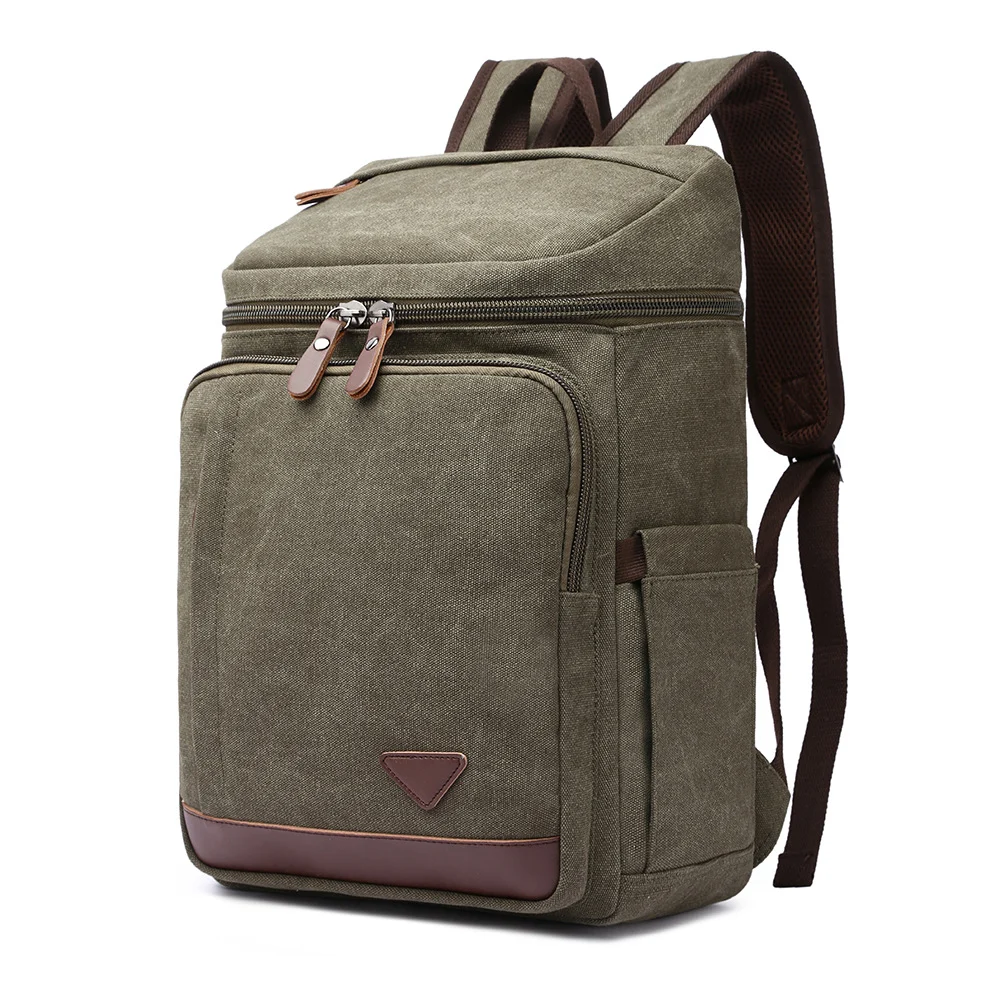
Sources: cross-referenced from factory sourcing disclosures. Peak-season lead times may extend 25%–40% beyond these bands.
Two negotiation realities deserve emphasis. First, MOQ is never a single fixed number—it is a package. A lower MOQ with a modestly higher unit price often produces a better outcome for both parties than a rigid MOQ refusal, because the factory recovers fixed costs through price rather than volume. Second, sample lead time and bulk lead time are separate clocks. A factory capable of a 7-day sample is not necessarily capable of a 20-day bulk run; the former exercises sample-room capacity, the latter exercises production-line capacity. Buyers should request both figures in writing and tie them to milestone payments.
-
Fabric and Hardware: Where Canvas Backpacks Succeed or Fail in the Field
Canvas is the visible material, but field failures in canvas backpacks are disproportionately traceable to hardware and construction details rather than the shell fabric itself. Pre-shipment inspection data consistently flags seam strength under load, zipper pull-force failure, dye-lot color mismatch, and branding placement errors as the most frequent defect categories. Buyers who lock specifications at the component level reduce return rates before the first container ships.
Fabric weight is the first specification to anchor. For high-durability promotional and daily-use canvas, the 2026 benchmark sits at a minimum of 10 oz to 16 oz fabric weight. Below that band, the bag may survive a single campaign but will not sustain repeat use—and repeat use is precisely what separates a branded backpack from a disposable tote. Waxed canvas at 12–16 oz provides the structural body that unlined heritage shapes require; lighter canvas requires interfacing or lining that adds cost and can introduce its own failure points.
Zipper selection is a cost-performance decision, not a brand loyalty exercise. YKK #5 coil zippers are rated for 3,000+ pull cycles and add roughly USD 0.60–1.50 to final unit cost depending on compartment count. SBS #5 coil zippers, rated at 2,000+ cycles, offer credible performance at lower cost for main compartments in the USD 20–50 retail band. A pragmatic specification for commuter-oriented canvas backpacks places SBS on the main compartment and YKK (or YKK Aquaguard for water resistance) on the laptop sleeve, where friction and open-close frequency are highest. Buyers should also specify pull-force acceptance criteria: slider engagement force in the 8–15 N range for a #5 coil, with detachment force exceeding 150 N.
Table 2. Hardware and branding specification benchmarks for canvas backpack OEM programs
Component / process | Benchmark specification | Cost impact (indicative) | Buyer note
Main shell fabric | 10–16 oz cotton canvas; waxed canvas 12–16 oz for heritage shapes | Base material cost driver | Confirm weight in oz/yard², not a vague “heavy canvas” claim
Main compartment zipper | SBS #5 coil, 2,000+ cycles | Lower-cost option | Acceptable for USD 20–50 retail price band
Laptop sleeve zipper | YKK #5 or YKK Aquaguard, 3,000+ cycles | +USD 0.60–1.50 per bag | High-friction zone; do not downgrade
Embroidery (front panel) | 300–500 unit MOQ typical; stitch-count dependent | +USD 1.20–3.50 per unit | Most durable branding method on canvas
Woven label (seam-sewn) | 500–1,000 label MOQ | +USD 0.08–0.18 per label | Standard premium finishing touch
Screen print (flat graphics) | 1–4 colors on coated panels | +USD 0.15–0.35 per color per unit | Verify ink compatibility with coating
Sources: zipper cycle ratings and pull-force thresholds; branding method costs and MOQs.
In OEM and private label programs, Qingyuan Hongjin Bag Co., Ltd. can work backward from the buyer’s target retail price band to define fabric weight, zipper grade, and branding process combinations, reducing the common “good sample, downgraded bulk” problem. Custom inquiries can be sent to admin@hongjin-bag.com.
-
Compliance and Tariff Exposure: What Buyers Must Verify Before the Deposit
Customs classification for canvas backpacks falls under HS heading 4202. The subheading and duty rate depend on the outer surface material, which means a canvas backpack with a leather trim panel may classify differently from an all-textile bag. For textile-material backpacks under 4202.92, the US MFN duty rate is approximately 17.6%, while the EU rate sits near 3.7% to 9.7% depending on the specific sub-line. These figures are baseline references, not landed-cost calculations; buyers must confirm the applicable HTS or TARIC line for their exact material composition and origin.
Beyond tariff classification, two compliance documents separate audited factories from trading intermediaries. For US-bound children’s backpacks, CPSIA compliance requires third-party lab testing for lead content, phthalates, and drawstring safety, plus a Children’s Product Certificate. For adult-focused canvas bags, CPSIA testing is generally not mandatory, but flammability and colorfastness checks remain relevant quality gates. For EU-bound programs, REACH/SVHC compliance on the fabric finish—particularly the wax compound in waxed canvas—is a mandatory documentary requirement, not a marketing preference.
On the sustainability side, GRS (Global Recycled Standard) certification has shifted from a differentiating claim to a procurement threshold for many EU and North American accounts. A GRS scope certificate proves the factory has been audited for recycled content handling; a Transaction Certificate (TC) proves the specific shipment contains the recycled content claimed. Certified recycled materials typically add 10%–25% to material cost and 1–3 weeks to lead time. Buyers should specify whether the certification requirement applies to the outer fabric only or to the full bag including lining and webbing—the latter narrows the supplier pool but produces a defensible end-product claim. Qingyuan Hongjin Bag Co., Ltd. can support buyers in confirming certification scope, testing items, and shipment document checklists during the sampling stage. Phone: +86-13501469599.
-
Customization Beyond the Logo: Where Private-Label Canvas Programs Create Differentiation
The most common misconception in B2B canvas backpack sourcing is that “custom” means printing a logo onto a stock bag. True OEM and private-label manufacturing allows buyers to specify dimensions, fabric weight, pocket layout, strap geometry, closure type, hardware finish, label placement, and packaging. For canvas backpacks specifically, the customization levers that carry the highest perceived-value return per dollar are:
Material provenance. Shifting from conventional cotton canvas to organic cotton, recycled cotton, or hemp canvas changes the sustainability narrative without requiring a wholesale redesign. Hemp canvas offers 3–5 times the tensile strength of cotton, natural antimicrobial properties, and a carbon-negative growth profile, though its initial hand-feel is coarser and may not suit every brand aesthetic.
Structural modularity. Removable pouches, adjustable dividers, and modular compartment systems allow a single base canvas backpack to serve commuting, travel, and leisure use cases, extending the SKU’s addressable market without multiplying tooling investment.
Packaging as brand extension. Custom poly bags, hang tags, woven labels, and branded carton packing are available from most mid-size and larger backpack factories as part of the production order, typically with a small MOQ premium on the first run. For corporate gifting and retail programs, packaging consistency is frequently the difference between a bag that feels commissioned and one that feels purchased off a shelf. Qingyuan Hongjin Bag Co., Ltd. supports custom, private label, and OEM production and can configure fabric, hardware, labels, and packaging as one project package.
-
Factory Selection Checklist for Canvas Backpack Buyers
The canvas category has a lower technical barrier to entry than hard-shell luggage or hydration packs, which means the supplier pool includes both genuine OEM factories and assemblers who outsource cutting and stitching. A structured vetting process protects the buyer’s timeline and deposit.
Verify the production line, not the showroom. Request video or photo documentation of the actual line that will produce the order, including cutting, stitching, and QC stations. A current business license matching the bank account name is the minimum documentation baseline.
Demand a pre-production sample from the exact material lot. A common failure mode in backpack sourcing is sample-grade material being upgraded to win the order and downgraded for mass production. The sample should be constructed from the same fabric, hardware, and trim lot that will be used in bulk, and the buyer should retain a signed reference sample.
Match certification claims to documentary evidence. BSCI, ISO 9001, and GRS certificates are meaningful only when the certificate scope covers the relevant product category and the buyer receives the corresponding Transaction Certificate for the shipment. A factory that cannot produce a TC for a GRS-labeled order is not delivering a certified product, regardless of what the scope certificate states.
Budget for pre-shipment inspection on first orders. AQL 2.5 sampling on a 1,000+ unit production run typically costs USD 150–300 and catches seam, zipper, dye-lot, and branding defects before the container leaves the factory. On a first order with a new canvas supplier, this is the highest-return quality investment available.
Table 3. Supplier vetting checklist for canvas backpack OEM programs
Vetting item | What to request | Red flag
Production capacity | Video of actual line for this product category | Only showroom photos or generic factory footage
Material lot traceability | Pre-production sample from bulk material lot; signed reference retained | Sample weight or hand-feel differs from bulk
Certification scope | BSCI/ISO/GRS scope certificate covering bags; TC for shipment | “We are GRS certified” without a TC
MOQ and lead time in writing | Both figures tied to milestone payments | Verbal commitments only
Inspection protocol | AQL 2.5 or equivalent pre-shipment inspection offered or accepted | Resistance to third-party inspection
For buyers screening canvas backpack OEM manufacturers, Qingyuan Hongjin Bag Co., Ltd. can provide production line videos, sampling procedures, and written MOQ and lead-time confirmation on request: admin@hongjin-bag.com.
-
What the 2026–2030 Trajectory Means for Canvas Buyers
Market forecasts place the global backpack market on a path from roughly USD 23 billion in 2026 toward USD 29–32 billion by 2030–2031, with sustainable and recycled materials, customization, and multifunctional design cited as leading growth vectors. For canvas backpack buyers, the implication is not that demand will simply lift every program. It is that the compliance and specification bar will continue to rise, and the suppliers who can document material provenance, hardware performance, and social audit compliance will absorb a disproportionate share of the branded and corporate-gift volume.
The buyers who succeed in this category are not the ones who negotiate the lowest per-unit quote. They are the ones who specify the zipper cycle rating, confirm the fabric weight in writing, secure the GRS Transaction Certificate, and budget for inspection before the deposit leaves their account. Canvas is a mature material. The sourcing discipline around it is what separates a repeatable private-label program from a one-off container of bags with a logo on the front panel.
For procurement teams evaluating a 2026 canvas backpack program, the starting point is a specification document, not a price list. Define the fabric weight, the hardware grade, the certification requirement, and the MOQ band. The factory conversation becomes significantly shorter—and significantly more honest—once those variables are on the table.
About Qingyuan Hongjin Bag Co., Ltd.
Qingyuan Hongjin Bag Co., Ltd. is a B2B backpack manufacturer specializing in bag production and supply, supporting OEM, custom manufacturing, and private label services. The company can support canvas backpack projects with fabric weight confirmation, hardware configuration, branding processes, packaging solutions, MOQ and lead-time communication, and can coordinate compliance documents and factory audit materials according to the target market.
For custom canvas backpack quotations, sampling, or factory audit documents, please contact:
Company: Qingyuan Hongjin Bag Co., Ltd.
Email: admin@hongjin-bag.com
Phone: +86-13501469599
Business scope: B2B backpack manufacturer | OEM | Custom | Private Label
Post time: Nov-02-2026